
How to Taper: Turning Fitness Into a Peak
You have done the training. The last two weeks decide whether it shows up. Here is what a taper actually does, the layout the science supports, and why the real answer is personal. For athletes and coaches.

You cannot get fitter in the last two weeks before a race. What you can do is stop hiding the fitness you already built. That is the whole job of a taper: shed the fatigue sitting on top of your form so that on race day the engine you spent months building finally shows up. Done well it is worth a couple of percent, which is the difference between a personal best and a near miss. Done badly it quietly wastes a training block. This guide covers what a taper is, the layout the research supports, and the part most articles skip, which is that the details are yours to find.
What a taper is, and what it is not
In the training load pillar we covered form: fitness minus fatigue. During a hard block you carry more fatigue than fitness, so form sits negative and you feel it in your legs. A taper is simply the stretch where you let that fatigue clear while holding on to the fitness. Fatigue fades fast and fitness fades slowly, so form climbs and you arrive fresh and sharp.
That is not the same as resting up. Stop training and you do not just lose fatigue, you start losing fitness too, and you turn up flat. A good taper is an active, deliberate reduction, not a holiday.
The one rule that matters most: cut volume, keep intensity
If you take one thing from this piece, take this. When you taper, cut how much you do, not how hard. Intensity is what holds your adaptations in place, and a lot of that is neural. The fast, race-specific efforts keep your neuromuscular system firing the way it will need to on race day, which is what keeps you sharp (Mujika 2004). Drop them and you go flat and lose that edge even when you are well rested (Mujika 2010). Volume is what carries the fatigue, so cutting it is what lets the fatigue clear.
In practice that means keeping the hard parts of your week and shortening them. Your interval session stays, it just has fewer reps. Your race-pace work stays right up to race week, it is just briefer. The classic mistake is going easy and short at the same time, which sheds fatigue but also blunts the very edge you are trying to bring to the line.
Keep training, just less of it
Cut volume, but do not stop. Keep your sessions frequent and short rather than rare and long. Training most days at a reduced load keeps you feeling like an athlete and keeps the machinery ticking over. Long gaps leave you rusty.
The general layout
Here is the shape the research supports. Reduce your training volume by somewhere around 40 to 60 percent, hold your intensity and your session frequency, and ease the volume down progressively rather than dropping it off a cliff. Do that over roughly two weeks. Across many studies, athletes who taper this way turn up meaningfully faster (Bosquet 2007; Mujika & Padilla 2003).
Scale the length to your event and your block. A short, sharp race off a moderate build might need only a week to ten days. A marathon usually wants around two weeks. An ultra or an Ironman, off a huge block of accumulated fatigue, often needs longer still. The more fatigue you have banked, the more time it takes to clear.
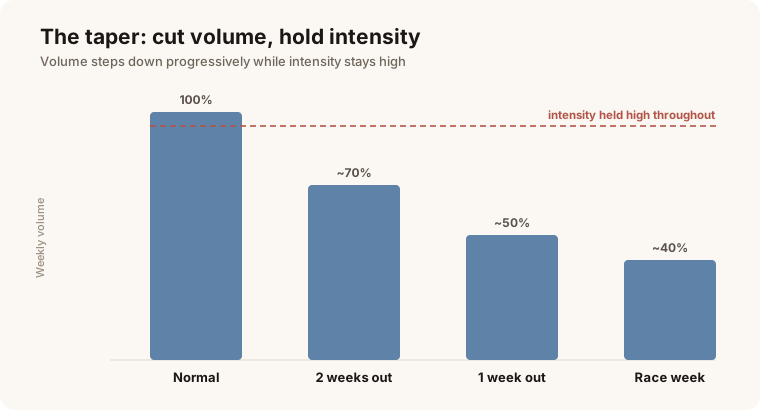
Cut volume progressively while intensity stays high. That is what sheds fatigue without losing your edge.
But the real answer is personal
This is where the science stops and the coaching starts. The layout above is a starting point, not a prescription, because tapering is genuinely individual. I have seen athletes with almost identical training loads and body weights peak best on quite different taper lengths. Part of that is biology, and part of it is everything outside training. Your taper has to account for your allostatic load, the total stress you carry from work, family, sleep and life, not just your sessions (McEwen 1998). The same block needs a longer, gentler taper when life around it is heavy. One athlete is flying after ten days, another needs the full two weeks and change to come good.
So treat the layout as your first experiment, not your final answer. Log what you did: how long you tapered, how you felt, your result and the conditions on the day. Then do it again next race and compare. Over a handful of races a pattern emerges and you learn your taper. That record, past times set against past tapers and conditions, tells you far more than any generic rule ever will. It is the single most useful thing a serious racer can build.
Feeling terrible is normal
Nobody warns you about this, so here it is. The middle of a taper often feels awful. Your legs feel heavy and dead, easy runs feel hard, and your body seems to be falling apart right when you want it sharp. This is normal. It is your body unloading, and it is often a sign the taper is working.
I have had tapers, and put athletes through tapers, where the whole two weeks felt like garbage, and then on race morning the legs turned up out of nowhere and felt unstoppable. The lesson is to hold your nerve. Do not panic and cram in an extra session to test the legs. Trust the plan, trust your race history, and let it come to you.
Common taper mistakes
- Dropping your race-specific intensity. The most common mistake and the costliest. Cut the sharp, race-pace efforts and you lose the neural stimulus that keeps you sharp, so you turn up rested but flat. Keep those efforts, just make them shorter.
- Cramming "just in case." A big last-minute session buys you nothing and costs you freshness.
- Tapering too long. You clear the fatigue and then keep going, sliding into detraining and flat legs.
- Tapering too short. You arrive still carrying fatigue and never feel the pop.
How to tell it is working
The clearest signal is the one from the pillar: your form should be climbing as the fatigue clears. Beyond the number, your race-pace efforts should start to feel easier at the same speed, and by the final few days the legs should feel light and springy. If you track load you can watch form rise into the race. In Be that curve is drawn for you, so you can see the fatigue lift and time your peak instead of guessing.
Bottom line
A taper does not build fitness, it reveals it. Cut your volume by roughly half, hold your intensity and frequency, and ease down progressively over one to three weeks depending on your event and how much fatigue you have banked. Then make it yours: treat every race as an experiment, keep a record of what worked, and dial it in over time. And when the middle of the taper feels dreadful, hold your nerve, because that flat, heavy feeling is often exactly what comes before a great race.
Put it to work
You do not have to guess whether the fatigue is clearing. Be tracks your fitness, fatigue and form from every session, so you can watch form rise through the taper and time your peak for the day that matters. Athletes use it to know when they are ready. Coaches use it to taper a whole squad and see who is coming good and who needs another easy day.
References
- Bosquet L, Montpetit J, Arvisais D, Mujika I. Effects of tapering on performance: a meta-analysis. Medicine & Science in Sports & Exercise. 2007;39(8):1358–1365. https://doi.org/10.1249/mss.0b013e31806010e0
- Mujika I, Padilla S. Scientific bases for precompetition tapering strategies. Medicine & Science in Sports & Exercise. 2003;35(7):1182–1187. https://doi.org/10.1249/01.mss.0000074448.73931.11
- Mujika I, Padilla S, Pyne D, Busso T. Physiological changes associated with the pre-event taper in athletes. Sports Medicine. 2004;34(13):891–927. https://doi.org/10.2165/00007256-200434130-00003
- Mujika I. Intense training: the key to optimal performance before and during the taper. Scandinavian Journal of Medicine & Science in Sports. 2010;20(s2):24–31. https://doi.org/10.1111/j.1600-0838.2010.01189.x
- McEwen BS. Protective and damaging effects of stress mediators. New England Journal of Medicine. 1998;338(3):171–179. https://doi.org/10.1056/NEJM199801153380307
Frequently asked questions
How long should a taper be?
It depends on your event, how much fatigue you have built, and your total life stress, so treat it as an experiment and learn your own. As a starting point the range is one to three weeks: a week to ten days for short races, around two weeks for a marathon, and longer for ultras and Ironman.
Should you reduce intensity during a taper?
No. Keep your intensity and cut your volume instead. The short, sharp, race-specific efforts maintain the neural stimulus that keeps you sharp; drop them and you arrive rested but flat.
Why do I feel terrible during my taper?
It is normal. Your body is unloading fatigue, and heavy, flat legs in the middle of a taper often come right before a great race. Hold your nerve and do not cram in extra training to test the legs.
How much should you cut training volume in a taper?
Around 40 to 60 percent, eased down progressively rather than dropped off a cliff, while you keep your training intensity and frequency.
Want help with tapering for your race?
Book a call