
Training Load Explained: Fitness, Fatigue and Form
Training load turns “how hard have I trained” into a number you can steer by. Here is what fitness, fatigue and form actually mean, how to read them, and where they mislead. For athletes and coaches.

You can train hard for weeks and still not know the one thing that matters: are you building fitness, or digging a hole? Two athletes can run the same miles and end up in completely different places, one sharpening, one sliding toward injury or burnout. The difference is load, and whether it was the right amount at the right time. Training load is simply a way to turn "how hard have I trained" into a number you can actually steer by. This guide covers what those numbers mean, how to read them, and where they mislead. It is written both for athletes managing themselves and for coaches managing a group.
Load is intensity times duration, not distance or time
An hour of easy jogging and an hour of threshold intervals are both "an hour," but they cost your body wildly different amounts. Distance and time alone miss that. Training load captures both halves, how hard and for how long, so that adding up every session gives you a running tally of the stress you have actually absorbed. That tally is the raw material for everything that follows.
The two kinds of load: what you did versus what it cost
There are two ways to measure a session, and the gap between them is the whole point.
External load is what you did: the power, pace, distance or reps. It is objective and precise, but it has no idea how you coped today.
Internal load is what it cost you. Heart-rate methods like TRIMP get part of the way there, but heart rate is confounded by heat, caffeine, sleep and cardiac drift, and it says little about strength or neuromuscular work.
The most complete single read is session RPE: how hard the session felt, multiplied by its duration (Foster 2001). It sounds crude, but it integrates everything the other measures miss, including fitness, fatigue, sleep, life stress, illness and heat. The same sixty-minute threshold session can feel like a five one week and an eight the next, and only RPE catches that the cost changed when the watch numbers did not.
So use every stream you can get. External load tells you what you did, internal load tells you what it cost, and when you want the truest single number for how hard a session really was, trust RPE, because it reflects the whole person and not just the engine. Combining complementary measures rather than leaning on one is also the position of the athlete-monitoring consensus (Bourdon 2017). It is the hierarchy Be follows: power where it exists, heart-rate load next, and session RPE for the read that captures the athlete's whole state.
Fitness and fatigue: acute versus chronic
Here is the idea that unlocks the rest. Every session does two things at once. It makes you fitter, and it makes you tired. Fitness builds slowly and fades slowly. Fatigue rises fast and clears fast. Track your load over two timescales and you can separate them.
Your recent load, roughly the last week, is a good proxy for fatigue. Call it acute load. Your load built up over about the last six weeks is a proxy for fitness. Call it chronic load. This is the impulse-response idea that goes back to the systems model of Banister and colleagues (Calvert & Banister 1976): fitness and fatigue are two trailing echoes of the same training, running on different clocks. In practice they are smoothed averages, roughly seven days for fatigue and forty-two for fitness, the same standard used by TrainingPeaks, Garmin, intervals.icu and Be.
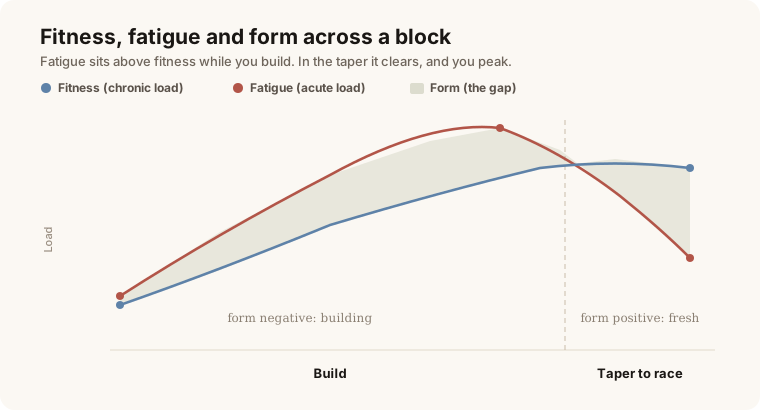
Fitness and fatigue are the same training on two clocks. Form is the gap: negative while you build, positive when you peak.
Form: fitness minus fatigue
If fitness and fatigue are two numbers, the gap between them is the one most worth watching. Subtract fatigue from fitness and you get form (often called training stress balance).
When form is negative you are carrying more fatigue than fitness. That is normal and necessary while you build. When you ease off, fatigue clears faster than fitness fades, form climbs, and you feel fresh and fast. That is the entire logic of a taper: you do not gain fitness in the last two weeks, you shed the fatigue that was hiding it. It is also why chasing a personal best in the middle of your hardest block rarely works, because the fitness is there but the fatigue is sitting on top of it.
Form has edges at both ends. Sit too deep in negative for too long and you are overreaching, heading toward injury, illness or burnout. Sit too fresh for too long and you are detraining. The skill is spending the right time in each, deep in fatigue when you are building, riding high form when it counts.
Spikes, and the acute:chronic ratio
If sudden jumps in load are where people get hurt, a number for "too much, too soon" would be useful. That is the appeal of the acute:chronic workload ratio: this week's load divided by your recent average, with a popular "sweet spot" and a "danger zone" above it (Gabbett 2016).
This is where you have to be careful, because the metric has taken serious and deserved criticism. The acute week is part of the chronic average, which manufactures correlation that is not really there (Lolli 2019). A single ratio also throws away the information you care about, since 1.5 can come from a big week on a big base or a small week on almost nothing, and those are not the same situation (Impellizzeri 2020). And a high ratio is often just an athlete returning from time off, deconditioned rather than in danger.
So treat the ratio as a flag, not a verdict. Its job is to make you ask a question, not to answer one. A jump you planned and recover from is adaptation. The same jump unplanned, or stacked on poor sleep, is risk, and the number cannot tell those apart. Read the trajectory rather than whether a snapshot crossed a line, and always against the phase the athlete is in. Be uses the ratio exactly this way: a flag that says "load has jumped, go and look," sitting beside other signals, never a rule that makes the call.
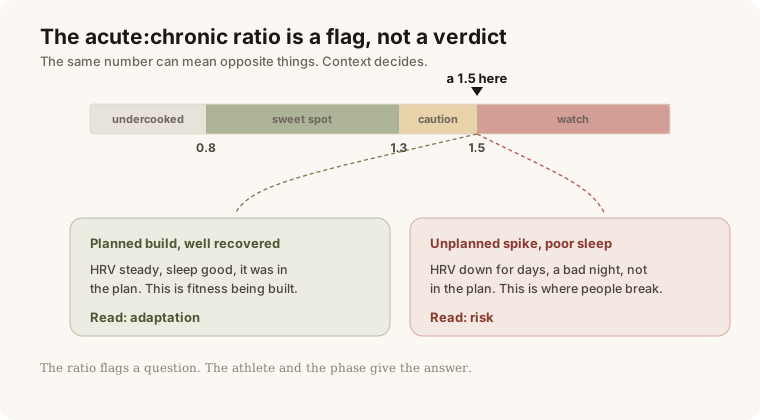
The same ratio can be adaptation or risk. The number flags a question; the athlete and the phase answer it.
Load is only half the story: recovery
Load tells you the stress you applied. It says nothing about how well you are absorbing it, and two athletes handed the same block will cope very differently. That is where recovery signals come in, and why the smartest use of load always pairs it with how the athlete is actually responding.
The main signals are heart-rate variability (HRV), resting heart rate, sleep and your own RPE trend. The single most important rule with all of them is to act on trends, not one noisy reading. A single low HRV morning means little. Several days below your normal range means something. It also matters to separate suppression your training explains, like the expected dip the morning after a hard session, from suppression it does not, which is the real warning.
Recovery is a big enough topic to get its own guide. The principle to carry from here is simple: load is what you asked of the body, recovery is what the body has left to give, and you need both to make a good call. It is the logic built into Be, which reads HRV against both a rested baseline and your current training state, acts on a multi-day trend rather than a single reading, and discounts the dip your last session already explains, so a deliberate build week is not mistaken for a problem.
How to actually use it
If you are an athlete managing yourself: build load gradually and let your fitness number climb over weeks rather than lurching up in a single fortnight. When several signals stack up at once, a poor night's sleep on top of a few days of suppressed HRV, take the hint and trim the session instead of grinding through. Ride high form into the races that matter. And treat every number as a prompt to check in with how you feel, not a replacement for it.
If you are a coach managing a group: the numbers are triage, a way to know who to look at first across a squad you cannot watch every day. A load spike, a multi-day HRV drop, a run of very hard-feeling sessions, each flags an athlete worth a conversation. The number starts the conversation. Your knowledge of the athlete and their phase finishes it.
Bottom line
Training load turns training into something you can measure, but the value is in how you read it. Separate fitness from fatigue by tracking load over different timescales, watch the gap between them to know when you are building and when you are ready, and use RPE for the truest read of what a session cost. Treat spike-detectors like the acute:chronic ratio as flags that prompt a question, never rules that make the call. And remember that load is only half the picture: pair it with recovery, act on trends over single readings, and let the numbers inform your judgment rather than replace it. That is the difference between training with data and being governed by it.
Put it to work
You do not need to work any of this out by hand. Be builds your fitness, fatigue and form from every session, reads your recovery the way this guide describes, and turns the numbers into a daily call you can act on. Athletes use it to see whether they are building fitness or digging a hole, and what to do about it today. Coaches use it to watch load, form and readiness across every athlete at once, so they always know who to look at first.
Understand your training, and your athletes', with Be
References
- Foster C. A new approach to monitoring exercise training. Journal of Strength and Conditioning Research. 2001;15(1):109–115. https://doi.org/10.1519/00124278-200102000-00019
- Calvert TW, Banister EW, Savage MV, Bach T. A systems model of the effects of training on physical performance. IEEE Transactions on Systems, Man, and Cybernetics. 1976;SMC-6(2):94–102. https://doi.org/10.1109/tsmc.1976.5409179
- Bourdon PC, Cardinale M, Murray A, et al. Monitoring athlete training loads: consensus statement. International Journal of Sports Physiology and Performance. 2017;12(s2):S2-161–S2-170. https://doi.org/10.1123/ijspp.2017-0208
- Gabbett TJ. The training–injury prevention paradox: should athletes be training smarter and harder? British Journal of Sports Medicine. 2016;50(5):273–280. https://doi.org/10.1136/bjsports-2015-095788
- Lolli L, Batterham AM, Hawkins R, et al. Mathematical coupling causes spurious correlation within the conventional acute-to-chronic workload ratio calculations. British Journal of Sports Medicine. 2019;53(15):921–922. https://doi.org/10.1136/bjsports-2017-098110
- Impellizzeri FM, Tenan MS, Kempton T, et al. Acute:chronic workload ratio: conceptual issues and fundamental pitfalls. International Journal of Sports Physiology and Performance. 2020;15(6):907–913. https://doi.org/10.1123/ijspp.2019-0864
Frequently asked questions
What is the difference between acute and chronic training load?
Acute load is your recent training, roughly the last week, and it tracks fatigue. Chronic load is what you have built up over about six weeks, and it tracks fitness. Fatigue rises and clears fast; fitness builds and fades slowly. Tracking load over both timescales lets you separate the two.
What is a good training stress balance (form) for a race?
Form (fitness minus fatigue) climbs when you taper, because fatigue clears faster than fitness fades. You want to arrive fresh but not detrained, which usually means letting form move clearly positive in the final week or two while you hold intensity. The exact figure is individual; the pattern of shedding fatigue without losing fitness matters more than a target number.
Is the acute:chronic workload ratio reliable?
Treat it as a flag, not a rule. It has real statistical problems (the acute week is part of the chronic average, and a single ratio hides very different situations), so hard danger-zone thresholds are not well supported. It is still useful as a prompt to look closer when load jumps relative to what an athlete has built, read in the context of their phase and how they feel.
What is the best way to measure training load?
Use more than one measure. External load (power, pace, distance) tells you what you did; internal load (heart-rate methods and session RPE) tells you what it cost. Session RPE, your rating of effort multiplied by duration, is the most complete single read because it captures the whole athlete: fitness, fatigue, sleep, stress and heat.
Want help with reading your training load?
Book a call