
How to Train Your Two Lactate Thresholds (and Escape the Grey Zone)
You know your two lactate thresholds. Here is how to actually train them: how much easy, how much threshold work, when the grey zone has its place, and a real training week built from a lactate test.


Most athletes who plateau are not lazy. They train hard, often five or six days a week. The problem is quieter than effort. Almost every session lands in the same middle gear: the easy runs creep a little too hard, the hard runs settle a little too soft and the whole week collapses into one unremarkable pace that nobody actually chose.
If you have had a lactate test, you already hold the fix. You know your two numbers. The question this article answers is the one the test itself does not: now what do you actually do with them?
For the full picture of what lactate is and what LT1 and LT2 mean, start with what a lactate test is and how it is used. Here I will assume you know roughly where your two lines sit and I want to turn them into a training week.
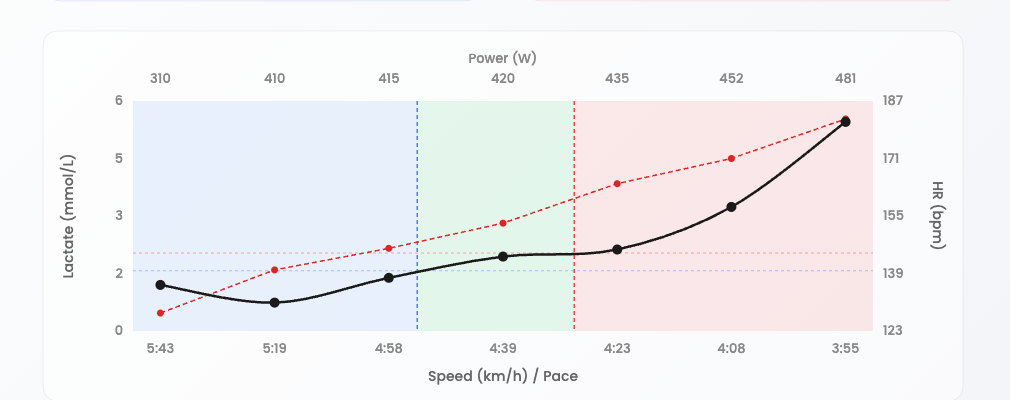
A real lactate test in the Be app. The blue line marks LT1, the top of easy. The red line marks LT2, the sustainable ceiling. The shaded bands are the three training zones. Notice my LT2 sits at 2.2 mmol/L, nowhere near the textbook 4.0. Your thresholds are yours.
Quick answer. Spend most of your training below LT1, where it is genuinely easy. Do your quality work at or just under LT2, controlled rather than maximal. Keep efforts above LT2 to small, deliberate doses. How much time you spend in the band between LT1 and LT2 is not fixed. It depends on your event, your training phase, how many hours a week you can train and how experienced you are. The mistake is not training in that band. It is living there by accident.
Who this is for: runners, triathletes and cyclists who know roughly where their thresholds sit and want to turn two numbers into a plan that actually uses them.
The real mistake: the grey zone by accident
The band between LT1 and LT2 has a bad reputation. You will hear it called the grey zone or the junk-mile trap. The advice that follows is usually blunt: stay out of it.
That advice is half right and the missing half matters. The problem was never the middle itself. The problem is drifting into it without meaning to. When easy days are run slightly too hard and hard days slightly too soft, everything bunches into one moderate intensity that is too taxing to recover from and too gentle to drive real change. You finish the week tired but no faster. That is the accident.
Deliberately prescribed work in that band is a completely different thing. Controlled, dosed time at threshold is one of the most powerful tools an endurance athlete has. For a lot of athletes it is the single most race-specific intensity they own. The skill is choosing it on purpose, not falling into it by default.
So the goal is not to avoid the grey zone. It is to stop visiting it by accident and to know exactly when it is the right place to be.
When the grey zone is exactly where you should be
How much of your training should sit in that middle band comes down to a few honest questions.
What are you training for? The longer events, the 10 km through to the half and full marathon, the 70.3, the time trial, are raced at or near threshold. For these athletes, tempo and threshold work is not a zone to avoid. It is race rehearsal. Push out to the ultra and full Ironman and race effort drifts back down toward LT1, so easy aerobic work dominates again. The shorter and faster the event, the more the work moves above LT2 and the less the middle earns its place.
How much can you train? This is the one most plans get wrong. A polarised distribution, lots of easy with a sharp dose of hard and very little in between, is what high-volume athletes do. It is observed precisely because they train so much (Seiler 2010; Stöggl and Sperlich 2015). If you train twenty hours a week you have to keep most of it easy, because you could never recover from doing that much hard and you do not need to, because the sheer mass of easy hours is itself a huge aerobic stimulus.
Flip that to five or six hours a week and the maths inverts. Spend eighty percent of five hours easy and you have done four easy hours, which is not enough volume to drive much change. You have also spent your scarce time on your lowest-return work. The time-limited athlete gets far more back by concentrating those few hours in the productive band. Polarised training is a luxury of high volume. When time is short, time is better spent in the grey zone.
How experienced are you? A newer athlete cannot absorb much top-end work and improves off almost anything, so a controlled diet of easy and threshold work is both safer and productive. A highly trained athlete has a deep base already and needs more specific, polarised stimulus to keep moving the needle.
Put together, it looks like this.
| Your situation | Lean toward | Why |
|---|---|---|
| 15+ hrs/week, shorter or faster goal, base phase | Polarised | Easy hours are abundant and you cannot do that much hard |
| 4 to 8 hrs/week, long-course goal, race phase | Threshold or pyramidal | Scarce hours pay back most in the productive middle |
| Somewhere in between | A blend that shifts by phase | Where most age-group athletes live |
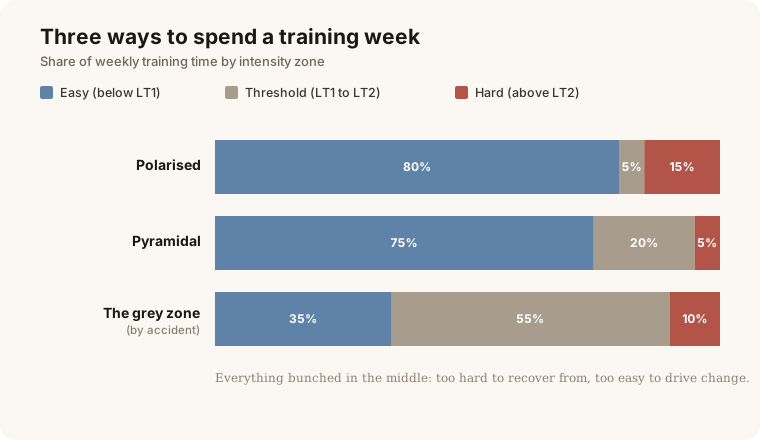
Three ways to spend a week. Polarised keeps the middle thin. Pyramidal gives threshold work a real share. The accidental grey zone, where most plateaued athletes sit, buries everything in the middle.
The training also moves through the season. Early base work skews more polarised, building the engine on easy volume. As you sharpen toward a race, the share of work at race-specific intensity grows. For most endurance events that means more time in the threshold band, not less (Casado et al. 2022).
Does this even apply to faster events?
A fair challenge: plenty of track athletes barely run long at all. So does any of this hold for fast events?
The answer hides in the energy systems. When researchers measured the aerobic and anaerobic contribution to track running, the aerobic share climbed fast with distance (Spencer and Gastin 2001).
| Event | Aerobic | Anaerobic |
|---|---|---|
| 200 m | ~29% | ~71% |
| 400 m | ~43% | ~57% |
| 800 m | ~66% | ~34% |
| 1500 m | ~84% | ~16% |
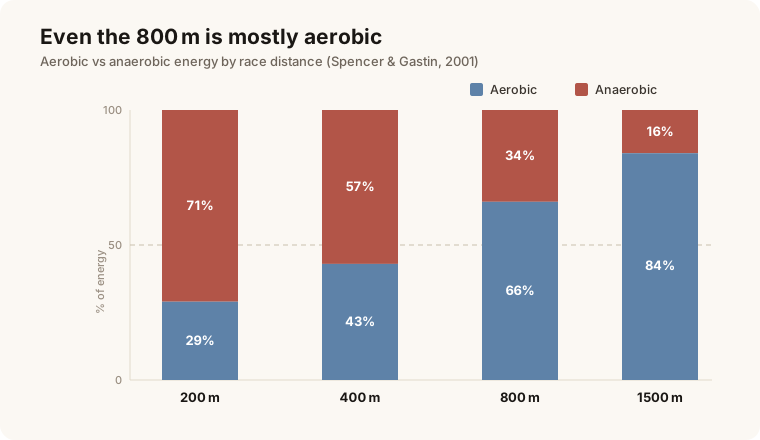
Aerobic versus anaerobic contribution by event. Even the 800 m is about two-thirds aerobic.
That 800 m number surprises almost everyone. It is already two-thirds aerobic and the 1500 m is more than eighty percent aerobic. Which is exactly why world-class middle-distance runners do build big aerobic bases and train their thresholds, racking up fifty to a hundred and twenty kilometres a week with a large share below threshold (Haugen et al. 2021). The Norwegian distance runners are the clearest example, stacking controlled threshold volume on a deep easy base.
The picture only flips at the true sprints. The 100 m and 200 m are overwhelmingly anaerobic. Here long slow running actively works against you. Large volumes of low-intensity endurance work blunt the strength, power and rate of force development a sprinter lives on, an effect known as the interference effect (Wilson et al. 2012). A sprinter's engine is built with speed, plyometrics, lifting and short, sharp reps, not long easy miles.
So the threshold framework applies from the middle distances upward, where the event is predominantly aerobic. The shorter and faster the race, the less it governs, until in the true sprints it falls away entirely. Knowing where that boundary sits is the difference between training your event and training someone else's.
How to train each line
Once you know your two numbers, the plan almost writes itself.
Below LT1 is the foundation. This is where most of your training should live, easy enough to recover from and repeat day after day. It builds the aerobic engine that everything else sits on. The hard part is discipline, because most athletes run their easy days too quickly. Police it: keep your heart rate under your LT1 figure, hold a pace clearly slower than your LT1 pace, or use the talk test and stay where you can speak in full sentences. This is not junk volume. It is the engine.
At or just under LT2 is your quality. Rather than one long, drifting tempo, break the work into controlled reps, for example five by six minutes, four by eight, or three by ten, held right at your LT2 pace and heart rate with short recoveries. Breaking it up lets you accumulate far more quality time at the intensity while keeping each rep honest. The aim is controlled, not maximal. It should feel strong and repeatable, never like a time trial. This is the heart of the lactate-guided approach: hold the line, do not drift past it.
Above LT2 is the sharpener. Short, potent doses, for instance four to five by three minutes hard, develop your top end. Powerful but expensive to recover from, so it stays a small slice of the week.
A week built from a real test
Theory is cheap, so let me build a week from the test in the chart above. Those lines came back at LT1 of 4:53/km at 148 bpm and LT2 of 4:29/km at 160 bpm, which puts half-marathon pace right around 4:30/km, a roughly 1:35 half. Say this athlete can train five to six hours a week and has a half marathon on the calendar.
Because time is limited and the race is run at threshold, this athlete leans pyramidal: a genuine block of threshold work, plenty of easy, a touch of top end.
| Day | Session |
|---|---|
| Mon | Rest |
| Tue | Threshold: 15 min easy, then 5 × 6 min at LT2 (4:29/km, ~160 bpm) with 90 sec jog, 10 min easy |
| Wed | Easy 40 min, comfortably under LT1 (slower than 4:53/km, under 148 bpm) |
| Thu | Rest or easy 30 min |
| Fri | Easy 40 min plus 5 × 20 sec strides |
| Sat | Long run 80 to 90 min easy, last 15 min lifted to half-marathon pace |
| Sun | Easy or cross-train 30 to 40 min |
Two quality touches, the Tuesday threshold block and the race-pace finish on Saturday, with everything else genuinely easy. That is the whole game in five and a half hours.
Change the inputs and the shape changes. Give this athlete twelve hours a week and you would add easy volume, lengthen the long run and keep the same two quality sessions, which naturally tips the week more polarised. Make them a 70.3 athlete and you would swap runs for rides and swims, do more sub-threshold tempo work and add brick sessions, because long-course racing sits just under threshold for hours.
How your two lines move and how to know it is working
Training is meant to move both lines. As you get fitter, LT1 and LT2 shift to faster paces and the gap between them widens, so you can hold harder efforts before LT2 finally gives way.
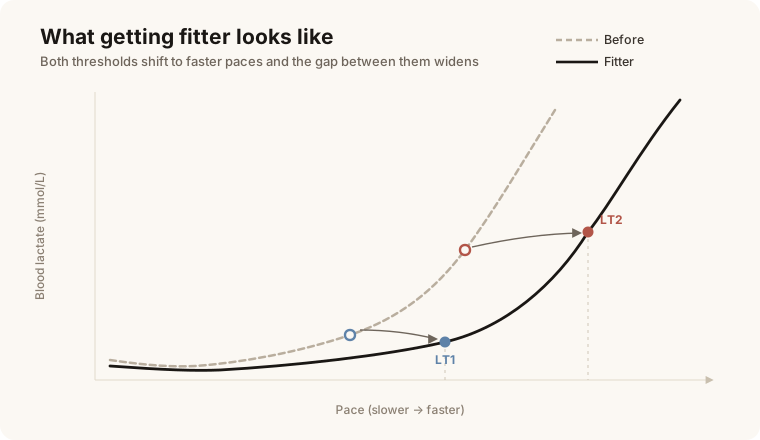
What getting fitter looks like. Both thresholds move to faster paces and the gap between them widens.
The two lines respond to different work. LT1 is driven mostly by easy aerobic volume and time, so it improves slowly over months of consistent base. LT2 responds to controlled threshold work. This is why a balanced plan trains both rather than chasing one.
You do not need a lab every fortnight to know it is working. Retest every couple of months to reset your zones. Between tests, watch the field markers. If your heart rate at a fixed easy pace is drifting down, your aerobic base is improving. If you can hold your threshold pace at a lower heart rate, or a faster pace at the same heart rate, LT2 is moving. Those trends, not any single number, tell you the training is landing.
Key takeaways
- The grey zone between LT1 and LT2 is only a problem when you land there by accident. Chosen on purpose, threshold work is one of your most powerful tools.
- How much of the middle you use depends on your event, your phase, your weekly hours and your experience. There is no single correct distribution.
- Polarised training is a luxury of high volume. When time is short, concentrating your hours in the threshold band pays back more.
- The threshold framework applies from the middle distances upward. Even the 800 m is two-thirds aerobic. Only the true sprints leave it behind.
- Train most of your volume below LT1, keep threshold work controlled rather than maximal and use small doses above LT2.
- Both thresholds move with training. Retest occasionally and track the trend between tests.
Find your two lines, train on the right side of each on purpose and the muddy middle stops stealing your progress.
Putting it to work
Setting your real zones and building a week that uses them is one of the first things I do with an athlete. I run a lactate test, fit your individual LT1 and LT2 rather than dropping you onto a generic number, then build your training around the two lines that are actually yours. If you want your thresholds set from real physiology and a plan that uses them, that is exactly what one on one sports science coaching is built for. Your zones live in the Be app so every session is prescribed against your real numbers. Book a consultation and we will start with a proper profile.
References
- Seiler S. What is best practice for training intensity and duration distribution in endurance athletes? International Journal of Sports Physiology and Performance. 2010;5(3):276–291. https://doi.org/10.1123/ijspp.5.3.276
- Seiler KS, Kjerland GØ. Quantifying training intensity distribution in elite endurance athletes: is there evidence for an "optimal" distribution? Scandinavian Journal of Medicine & Science in Sports. 2006;16(1):49–56. https://doi.org/10.1111/j.1600-0838.2004.00418.x
- Stöggl TL, Sperlich B. The training intensity distribution among well-trained and elite endurance athletes. Frontiers in Physiology. 2015;6:295. https://doi.org/10.3389/fphys.2015.00295
- Casado A, González-Mohíno F, González-Ravé JM, Foster C. Training periodization, methods, intensity distribution, and volume in highly trained and elite distance runners: a systematic review. International Journal of Sports Physiology and Performance. 2022;17(6):820–833. https://doi.org/10.1123/ijspp.2021-0435
- Spencer MR, Gastin PB. Energy system contribution during 200- to 1500-m running in highly trained athletes. Medicine & Science in Sports & Exercise. 2001;33(1):157–162. https://doi.org/10.1097/00005768-200101000-00024
- Haugen T, Sandbakk Ø, Enoksen E, Seiler S, Tønnessen E. Crossing the golden training divide: the science and practice of training world-class 800- and 1500-m runners. Sports Medicine. 2021;51(9):1835–1854. https://doi.org/10.1007/s40279-021-01481-2
- Wilson JM, Marin PJ, Rhea MR, Wilson SMC, Loenneke JP, Anderson JC. Concurrent training: a meta-analysis examining interference of aerobic and resistance exercises. Journal of Strength and Conditioning Research. 2012;26(8):2293–2307. https://doi.org/10.1519/JSC.0b013e31823a3e2d
Written by Brendon Villanueva, ESSA-accredited Sport Scientist at Be Sports Science Consulting (BExSpSc). This article is general information rather than individual medical or training advice. Check with a qualified professional before making big changes to your training.
Frequently asked questions
Is tempo or threshold training actually bad for you?
No. The grey zone between LT1 and LT2 is only a problem when you drift into it by accident, with easy days run too hard and hard days too soft. Prescribed deliberately, controlled threshold work is one of the most powerful and race-specific tools an endurance athlete has. The skill is choosing it on purpose rather than falling into it by default.
How much of my training should be easy?
It depends on how much you train. High-volume athletes keep most of their work easy, often around 80 percent, because they cannot recover from doing that much hard. If you only train five or six hours a week, spending 80 percent easy leaves too little stimulus, and you are better off concentrating more of your limited time in the threshold band. Polarised training is a luxury of high volume.
Do I need a lab lactate test to train my thresholds?
A test gives you the most accurate, individual LT1 and LT2, which is the cleanest way to set your zones. You can approximate them in the field, using the talk test for LT1 and a hard, evenly paced 30 minute effort for LT2, but those are estimates. A proper test removes the guesswork and is worth it if you are training seriously.
Should sprinters do long easy runs?
Generally no. The 100 m and 200 m are overwhelmingly anaerobic, and large volumes of slow running can blunt the strength and power a sprinter depends on, an effect known as the interference effect. The lactate-threshold framework applies from the middle distances upward, where events are predominantly aerobic. The shorter and faster the race, the less it applies.
Want help with building a training week around your lactate thresholds?
Book a call