
VLaMax: The Other Engine That Sets Your Threshold
Everyone knows VO₂max. Almost nobody talks about the other engine: VLaMax, your glycolytic power. It helps set your threshold, your fuel use and your endurance, and the science around it is more interesting than the hype suggests.

Everyone knows their VO₂max, or wants to. It is the famous number, your aerobic ceiling, how much oxygen you can burn. Far fewer people have heard of the engine sitting right next to it, the one that quietly helps set your threshold, your fuel use and how long you can hold a pace. That engine is VLaMax: your maximal glycolytic rate, or how fast your body can burn sugar and produce lactate. This piece covers what it is, how it is measured, how it is used to guide training, and where the science on it actually stands.
The engine everyone ignores
VO₂max tells you the size of your aerobic engine. VLaMax tells you the size of your glycolytic one: the maximum rate at which you can break down carbohydrate for fast energy, measured as how quickly lactate accumulates during an all-out effort, in mmol per litre per second. A sprinter has a big glycolytic engine and a high VLaMax, often around 0.8 to 1.0. A long-course triathlete has a small one, often 0.3 or lower. Neither number is good or bad on its own. What matters is the balance between the two.
Two engines, one athlete
Here is the idea that makes VLaMax worth understanding. Your metabolism at any moment is a tug-of-war between producing lactate and clearing it. Your glycolytic engine drives production, your aerobic engine and your mitochondria drive clearance. Where those two balance out is, roughly, your threshold (Mader 2003).
This is why two athletes with an identical VO₂max can have very different thresholds and race very differently. Give one of them a high VLaMax and they flood themselves with lactate at a modest pace, so their threshold sits low and they burn through carbohydrate fast. Give the other a low VLaMax and they make far less lactate at the same pace, so their threshold sits higher and they lean more on fat. Same aerobic ceiling, completely different endurance engine.
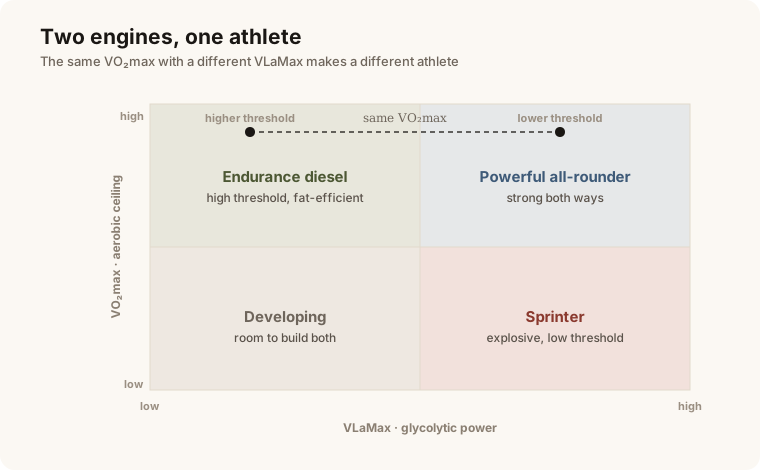
Same aerobic ceiling, different VLaMax, different athlete. Your endurance is the balance of the two engines.
Why endurance athletes usually want it low
For anything long, a lower VLaMax is generally the goal. Less lactate produced at a given intensity means a higher fractional threshold, better fat oxidation and spared glycogen, all of which matter over hours (San-Millán & Brooks 2018). This is the physiology behind why elite endurance athletes are such metabolic misers.
But not too low. You still need glycolytic power to surge over a climb, cover a move, or kick to the line. A marathoner and a 1500 m runner want very different VLaMax values, and a mid-distance athlete sits in between. The right answer is not "as low as possible," it is "matched to your event."
How you shift it
VLaMax responds to training in fairly predictable directions. You push it down with the classic endurance toolkit: high aerobic volume, long steady work, and high-cadence, low-force efforts. You push it up with the opposite: short maximal sprints, glycolytic intervals and heavy strength work.
Fasted and low-carbohydrate sessions are often added to the "push it down" list, on the logic that starving glycolysis of fuel forces more fat use. The mechanism is real, and low carbohydrate availability does reduce glycolytic flux and raise fat oxidation in the short term. But the harder claim, that fasted work meaningfully lowers VLaMax or improves endurance, is not settled. The performance evidence for low-carbohydrate training is mixed at best, and in trained athletes it can blunt high-intensity quality and economy (Burke 2017). Treat it as a deliberate tool with real trade-offs, not a default.
Either way, an athlete whose profile shows a high VLaMax capping their endurance is steered toward more aerobic work, and one who lacks a finishing gear is given more glycolytic stimulus.
How it is measured
The test is short and brutal. After a warm-up and a baseline lactate reading, you do a single all-out sprint of roughly 10 to 15 seconds, then stop dead while lactate is sampled every minute until it peaks. VLaMax is the rise in lactate divided by the sprint time, minus the first few seconds your phosphocreatine covers before glycolysis really kicks in (Harnish 2023). On its own that number is just glycolytic power. Its real use comes when it is read alongside your VO₂max and your threshold, so you can see how the two engines combine.
Where the science actually stands
This is the part the marketing skips, and it is the most useful part. VLaMax is a genuinely useful lens, but it is a modelled construct, not a gold-standard measurement, and it pays to know the difference.
On the credit side, the 15-second test is reliable, it repeats well from day to day, and it correlates strongly with sprint and strength performance (Quittmann 2025). Combined with VO₂max in a metabolic model, it predicts the maximal lactate steady state well enough to be useful in practice (Poffé 2024).
On the caution side, there is no direct validation of VLaMax, and there may never be, because you cannot directly measure maximal glycolytic rate in a living athlete. It is sensitive to how you test it, since your carbohydrate status, the timing and the sampling protocol all move the number. And its independent value for longer events is genuinely debated. A recent review of sixty studies concluded that its use for efforts beyond about a minute is still inconclusive, even as it is clearly informative for sprint performance (Quittmann 2025).
So the honest position is the one that applies to most single metrics. VLaMax is a good profiling lens, most trustworthy when read alongside your VO₂max rather than on its own, and a useful season-long tuning tool. It is not a number to chase in isolation, and it is not the last word on your endurance.
Bottom line
VLaMax is the engine most people never hear about: your glycolytic power, the partner to VO₂max that helps set your threshold and your fuel use. Endurance athletes generally want it lower, but not so low they lose their punch, and it shifts with training in predictable ways. Treat it as a lens for understanding your metabolism, best read next to your VO₂max, and stay honest that it is a modelled estimate rather than a measured truth. Used that way, it explains a lot about why two athletes with the same ceiling can race so differently.
Put it to work
Be computes your VLaMax the proper way. From a short all-out sprint and a few lactate samples, the exact protocol described above, it works out your maximal glycolytic rate and how quickly you clear the lactate afterwards, and keeps it alongside your threshold testing. So instead of guessing at your glycolytic power, you and your coach can see it and track how it shifts with training. Athletes use it to understand their own metabolism. Coaches use it to profile athletes and aim their work.
See your glycolytic profile in Be
References
- Mader A. Glycolysis and oxidative phosphorylation as a function of the cytosolic phosphorylation state and power output of the muscle cell. European Journal of Applied Physiology. 2003;88(4):317–338. https://doi.org/10.1007/s00421-002-0676-3
- Brooks GA. The science and translation of lactate shuttle theory. Cell Metabolism. 2018;27(4):757–785. https://doi.org/10.1016/j.cmet.2018.03.008
- San-Millán I, Brooks GA. Assessment of metabolic flexibility by means of measuring blood lactate, fat, and carbohydrate oxidation responses to exercise in professional endurance athletes and less-fit individuals. Sports Medicine. 2018;48(2):467–479. https://doi.org/10.1007/s40279-017-0751-x
- Burke LM, Ross ML, Garvican-Lewis LA, et al. Low carbohydrate, high fat diet impairs exercise economy and negates the performance benefit from intensified training in elite race walkers. The Journal of Physiology. 2017;595(9):2785–2807. https://doi.org/10.1113/JP273230
- Harnish CR, et al. Reliability of the 15-s maximal lactate accumulation rate (VLamax) test for cycling. Physiologia. 2023;3(4):542–551. https://doi.org/10.3390/physiologia3040040
- Poffé C, et al. INSCYD physiological performance software is valid to determine the maximal lactate steady state in male and female cyclists. Frontiers in Sports and Active Living. 2024;6:1376876. https://doi.org/10.3389/fspor.2024.1376876
- Quittmann OJ. Maximal lactate accumulation rate: current evidence and future directions for exercise testing and training. European Journal of Applied Physiology. 2025;126(1):1–36. https://doi.org/10.1007/s00421-025-06022-7
Frequently asked questions
What is VLaMax?
VLaMax is your maximal glycolytic rate: how fast your body can break down carbohydrate and produce lactate, measured in mmol per litre per second. It is the glycolytic counterpart to VO₂max, your aerobic ceiling, and together the two shape your threshold and your fuel use.
Do endurance athletes want a high or low VLaMax?
Generally low. A lower VLaMax means less lactate produced at a given pace, a higher threshold and better fat oxidation, which all help over long events. But not too low, because you still need some glycolytic power to surge over climbs and finish hard.
How is VLaMax measured?
From a short all-out sprint of about 10 to 15 seconds, with blood lactate sampled before and repeatedly afterwards until it peaks. VLaMax is the rise in lactate divided by the effective sprint time, minus the first few seconds your phosphocreatine covers before glycolysis takes over.
Is VLaMax accurate and validated?
It is a reliable and specific measure of glycolytic power, but it is a modelled construct rather than a directly validated number, and it is sensitive to your carbohydrate status and testing protocol. Its value for efforts longer than about a minute is still debated, so it is best read as a profiling lens alongside your VO₂max rather than chased in isolation.
Want help with profiling your metabolism?
Book a call