
Strength Training for Runners, Cyclists and Triathletes (and How It Should Differ)
Runners, cyclists and triathletes share the goal but not the gym plan. How strength work should differ by sport: plyometrics and single-leg for runners, heavier max-force for cyclists, durability for triathletes and how to periodise it across a season.

Walk into most gyms and you will see endurance athletes all doing roughly the same strength session: a few sets of squats, some lunges, a plank, done. It is better than nothing. But a cyclist grinding through box jumps or a runner who only ever pushes a leg-press sled is training someone else's sport. The goal is shared. The tools should not be.
Most strength habits come from a generic "strength for endurance" plan. This article is about the part those plans skip: how the work should change depending on whether you run, ride or do all three.
For the groundwork on why endurance athletes should lift at all and how much, start with how much strength training endurance athletes actually need. Here I will assume you are sold on lifting and I want to make it sport-specific.
Quick answer. All three sports lift heavy, compound and roughly twice a week. The difference is emphasis. Runners need heavy strength plus plyometrics and single-leg work because running is high-impact and built on elastic return. Cyclists go heavier on bilateral max-force lifting and skip the jumps because cycling is sustained force with no impact and they can handle more load. Triathletes use strength mostly to stay durable across three sports, building in the off-season and maintaining in-season.
Who this is for: runners, cyclists and triathletes who already lift or are about to start and want their gym work to actually match their sport.
It comes down to impact and how you make force
Two questions explain almost every difference: how much impact your sport involves and what kind of force it asks for (Rønnestad and Mujika 2014).
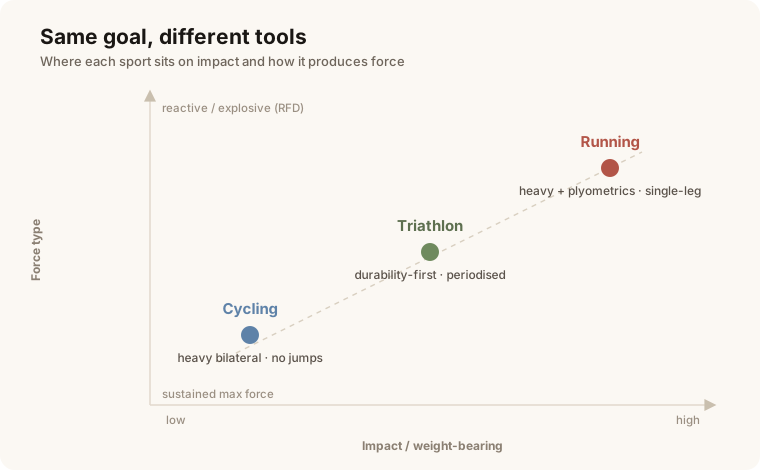
Where each sport sits. Cycling leans on sustained force with no impact, running on impact and elastic return, triathlon in between.
Running is high-impact and runs on the stretch-shortening cycle: your tendons and muscles store and return elastic energy with every stride like a spring. That rewards reactive, explosive qualities. Cycling has no impact at all. It is smooth and seated, asking for sustained force at a steady cadence, a strength-endurance quality rather than a rate-of-force one. Triathlon sits in the middle and carries the extra problem of fitting everything in. Once you see where your sport sits, the gym plan follows.
What you're actually training
"Force" is doing a lot of work in that sentence, so it is worth pulling apart. Three qualities sit behind all of this.
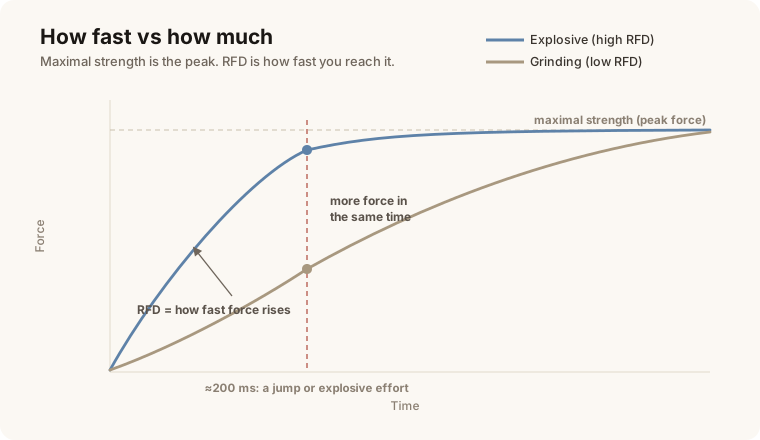
Two athletes can share the same maximal strength, the same peak. What separates them is how fast they get there. In an explosive effort like a jump you have only around 200 milliseconds, so the one with the higher rate of force development has produced far more force by the time the foot leaves the ground.
- Maximal strength is the most force you can produce in a single effort, however long it takes. It is the base everything else is built on.
- Rate of force development (RFD), sometimes called power, is how fast you can produce that force. It is the explosive quality behind a jump or a sprint off the line and it matters because fast movements leave almost no time to build force.
- Strength-endurance is producing force over and over without it fading, which is what a cyclist grinding up a climb actually needs.
These are not separate skills so much as points on one spectrum.
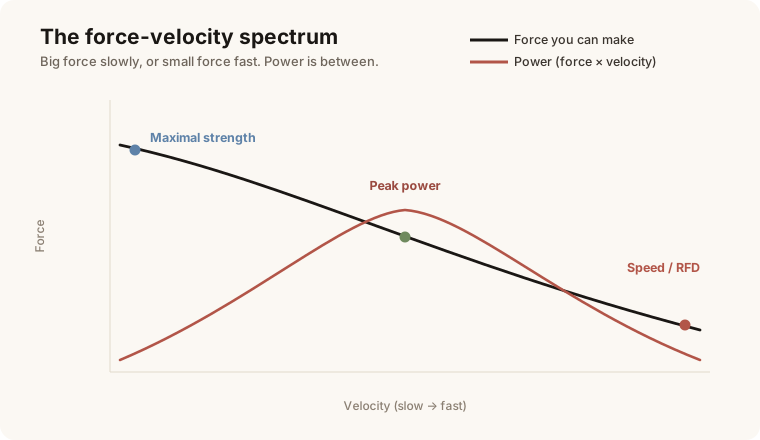
The force-velocity spectrum. You can make big force slowly (maximal strength) or small force fast (speed). Power is the product of the two and peaks in the middle. Different sports and different lifts target different points along it.
Running lives toward the fast, reactive end. Cycling sits at the slow, maximal-force end. Triathlon needs a bit of each. That is the force-type axis from the quadrant in more detail.
Runners: heavy strength, plus spring
For runners, lifting does two jobs. Heavy strength work (squats and the like) improves running economy, meaning you use less oxygen at the same pace (Blagrove 2018). On top of that, runners benefit from plyometric and reactive work (hops, bounds and jumps) that builds the tendon stiffness and elastic return running leans on. A review of the evidence found both heavy lifting and explosive training improve running economy (Denadai 2017).
Because running is a single-leg sport (one foot on the ground at a time), single-leg work earns its place: split squats, step-ups, single-leg calf raises. The calves, Achilles and feet take a pounding with every stride so loading them deliberately builds durability against the most common running injuries.
Keep it predominantly lower body with a bit of core for trunk control. And respect the impact you are already absorbing on the road. Your legs are not fresh so the strength volume has to fit around your running, not bury it.
Cyclists: heavier and no jumps
Cycling flips two things. First, it is an endurance-strength output, not a rate-of-force one. You produce force over and over at a cadence rather than exploding off the ground, so plyometrics earn very little here. Cyclists are far better served by heavy bilateral max-force lifting (both legs at once): squats, leg press, the movements that raise the ceiling of force you can put through the pedals. That heavy strength improves cycling economy and the ability to hold power late in a race (Vikmoen 2016).
Second, because cycling is not weight-bearing, the legs are not being beaten up by impact between sessions. So cyclists can usually handle more strength load than runners. They can go heavier and a touch more often and recover from it. Keep it bilateral and lower-body dominant with some core for position. The jumps a runner needs, a cyclist can mostly leave at the door.
Triathletes: strength as insurance
For triathletes the calculus changes because there are three sports to keep happy and never enough hours. Here strength earns its keep mostly as durability. The sheer load of swimming, riding and running stacks up and the body starts to grumble. Strength work keeps joints robust and heads off the niggles that derail a block. The evidence is strong: structured strength training cuts sports injuries to under a third (Lauersen 2014).
It still pays off in performance. A six-month trial in long-distance triathletes found progressive strength training improved both cycling and running economy without adding body mass (Luckin-Baldwin 2021). The trick is fitting it in. With three disciplines already filling the week, triathletes face the hardest version of the interference problem, where too much endurance work can blunt strength gains (Wilson 2012). The answer is a minimal effective dose: full-body and efficient, lower-body biased for the bike and run, with some pulling work for the swim and shoulder health.
The timing matters more here than for anyone else, which brings us to periodisation.
At a glance
Here is the whole comparison in one picture: the five tools that matter, weighted by sport.
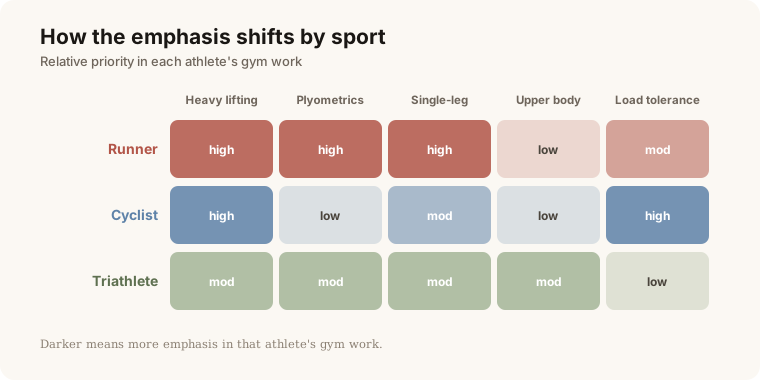
The same five tools, weighted differently by sport. Darker means more emphasis.
Periodising it across a season
Strength is not one fixed setting you hold all year. The volume should rise and fall with your racing while the load itself stays heavy.
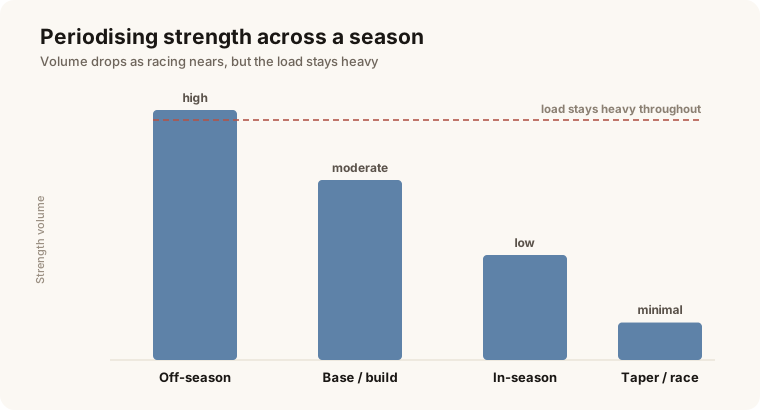
Volume falls as racing nears while the load stays heavy. The off-season is for building, the race season for maintaining.
The off-season is when you build: the heaviest, highest-volume block of the year, while racing is far away. As the season approaches you convert that into maintenance, keeping the load heavy but cutting the volume right back, often to a single weekly session, so it supports your sport without stealing from it. Into a taper you trim further, holding just enough to keep the neural edge while you shed fatigue. How lean the in-season dose gets and how far out you ease off before a race comes down to the athlete: their training history, how fast they recover and how strength-dependent the event is.
Each sport bends that arc a little:
- Runners introduce plyometrics in the base phase, building a tolerance first, then ease them back a few days to a couple of weeks before a key race, since reactive work carries the most residual fatigue.
- Cyclists can hold heavier strength deeper into the season. In-season maintenance is genuinely worth it: cyclists who kept a strength-maintenance session through the competitive season outperformed those who dropped it (Rønnestad 2010).
- Triathletes treat the off-season as the build window, when discipline volume is lowest, then shift to strict maintenance once the swim, bike and run load climbs.
What stays the same
For all the differences, do not lose the shared core. Every endurance athlete benefits from heavy, compound lifting done well, around twice a week, progressed over time. The squat does not stop being useful because you ride instead of run. These are differences of emphasis, not of principle. And the principle comes first. If you have not nailed the basics yet, start with the fundamentals before worrying about the fine-tuning.
Key takeaways
- The same goal, a stronger and more durable engine, asks for different tools in each sport.
- Runners need heavy strength plus plyometrics and single-leg work because running is high-impact and elastic.
- Cyclists go heavier on bilateral max-force lifting, skip the jumps and can handle more load because there is no impact.
- Triathletes use strength mostly for durability, built in the off-season and maintained in-season around a packed schedule.
- Periodise it: volume rises and falls with your racing while the load stays heavy.
- Underneath the differences, every endurance athlete is doing heavy, compound lifting twice a week.
Putting it to work
Matching your strength work to your sport and your season is part of how I coach. I build the gym plan around the demands you actually face, whether that is a runner's springs, a cyclist's raw force or a triathlete's durability across three disciplines. Then I periodise it around your race calendar so it supports your training instead of fighting it. If you want a plan built for your sport rather than a generic template, that is what one on one sports science coaching is for. It all sits alongside your training in the Be app. Book a consultation and we will build it around your races.
References
- Rønnestad BR, Mujika I. Optimizing strength training for running and cycling endurance performance: A review. Scandinavian Journal of Medicine & Science in Sports. 2014;24(4):603–612. https://doi.org/10.1111/sms.12104
- Blagrove RC, Howatson G, Hayes PR. Effects of strength training on the physiological determinants of middle- and long-distance running performance: a systematic review. Sports Medicine. 2018;48(5):1117–1149. https://doi.org/10.1007/s40279-017-0835-7
- Denadai BS, de Aguiar RA, de Lima LCR, Greco CC, Caputo F. Explosive training and heavy weight training are effective for improving running economy in endurance athletes: a systematic review and meta-analysis. Sports Medicine. 2017;47(3):545–554. https://doi.org/10.1007/s40279-016-0604-z
- Vikmoen O, Ellefsen S, Trøen Ø, et al. Strength training improves cycling performance, fractional utilization of VO₂max and cycling economy in female cyclists. Scandinavian Journal of Medicine & Science in Sports. 2016;26(4):384–396. https://doi.org/10.1111/sms.12468
- Luckin-Baldwin KM, Badenhorst CE, Cripps AJ, Landers GJ, Merrells RJ, Bulsara MK, Hoyne GF. Strength training improves exercise economy in triathletes during a simulated triathlon. International Journal of Sports Physiology and Performance. 2021;16(5):663–673. https://doi.org/10.1123/ijspp.2020-0170
- Lauersen JB, Bertelsen DM, Andersen LB. The effectiveness of exercise interventions to prevent sports injuries: a systematic review and meta-analysis of randomised controlled trials. British Journal of Sports Medicine. 2014;48(11):871–877. https://doi.org/10.1136/bjsports-2013-092538
- Rønnestad BR, Hansen EA, Raastad T. In-season strength maintenance training increases well-trained cyclists' performance. European Journal of Applied Physiology. 2010;110(6):1269–1282. https://doi.org/10.1007/s00421-010-1622-4
- Wilson JM, Marin PJ, Rhea MR, Wilson SMC, Loenneke JP, Anderson JC. Concurrent training: a meta-analysis examining interference of aerobic and resistance exercises. Journal of Strength and Conditioning Research. 2012;26(8):2293–2307. https://doi.org/10.1519/JSC.0b013e31823a3e2d
Written by Brendon Villanueva, ESSA-accredited Sport Scientist at Be Sports Science Consulting (BExSpSc). This article is general information rather than individual medical or training advice. Check with a qualified professional before making big changes to your training.
Frequently asked questions
Do cyclists need plyometrics?
Not really. Cycling is a sustained-force, endurance-strength output, not an explosive one and it carries no impact, so the reactive qualities plyometrics build add little. Cyclists get far more from heavy bilateral lifting like squats and leg press. Save the jumps for runners, whose sport runs on elastic return.
Can cyclists lift heavier than runners?
Generally they can handle more strength load. Cycling is not weight-bearing, so a cyclist's legs are not beaten up by impact between sessions the way a runner's are, which leaves more capacity to recover from heavy lifting. Runners have to fit strength around the pounding they already absorb on the road.
How should triathletes fit strength around three sports?
Treat it mostly as durability and use a minimal effective dose. Build strength in the off-season when discipline volume is lowest, then drop to a single maintenance session in-season. Keep it full-body and efficient, lower-body biased for the bike and run with some pulling work for the swim.
Should beginners worry about sport-specific strength?
Not at first. Early on, general heavy compound lifting helps every endurance athlete and the sport-specific tweaks, plyometrics for runners or heavier loads for cyclists, matter more once you have a base. Build the foundation first, then refine.
Want help with sport-specific strength training for endurance athletes?
Book a call