
Strength Training for Trail and Ultra Runners (and How the Mountains Change It)
Your road strength work still applies off-road, but the mountains add four demands the road never makes. Here's what changes, and how the emphasis shifts as you grow as an athlete.

Plenty of road runners arrive on the trail already strong. They squat, they deadlift, and they've read that lifting makes them more economical. They're right. Then they run their first proper mountain race, point themselves down a long descent, and three days later they can't walk down stairs. The engine was never the problem. The trail just asked their legs a question the road never had.
That question is the whole article. Everything in how much strength training endurance athletes actually need still holds off-road, and how strength differs for runners, cyclists and triathletes covers the road layer. Trail and ultra add four demands on top. How hard you train each one shifts with where you are as an athlete and what your race throws at you.
Quick answer. Trail and ultra add four demands the road doesn't: braking descents, uneven ground, long climbs and hours on feet. Everyone trains all four, but how much you weight each shifts with your experience and your race. Newer trail runners build a base and shore up the terrain skills they're missing. Seasoned mountain runners lean on the trail itself and use the gym mainly to stay durable and injury-free.
Who this is for: runners moving from road to trail, and trail and ultra runners who want their gym work to match the mountains.
The four things the mountains add
1. Braking descents → eccentric strength. The big one. Running downhill, your quads work eccentrically. They lengthen under load to brake each step, and that's the exact contraction that tears muscle fibres and leaves you sore for days (Eston 1995). It's why descending, not climbing, wrecks people late in a hilly race. The answer is to build eccentric strength and to actually run downhills, because the protection is partly specific to braking.
2. Uneven ground → single-leg control and ankle strength. Roots, rocks and camber mean you're rarely balanced evenly, and your ankle is constantly correcting. The road never asks for that. Single-leg strength and ankle and foot stability build the control that keeps a rolled ankle from becoming a DNF.
3. Steep climbs → posterior chain and calves. Steep climbing, often fast-hiked in an ultra, leans hard on your glutes, hips and calves for far longer than any road hill. Strength there pays off the moment the gradient bites.
4. Hours on feet → durability. The longer you're out, the more your neuromuscular system frays. After an extreme mountain ultra, runners lose a real chunk of their ability to even activate their muscles (Millet 2011). Durability means holding form and economy deep into fatigue rather than just being fast when fresh. It's increasingly recognised as its own trainable quality (Maunder 2021), and strength helps build it.
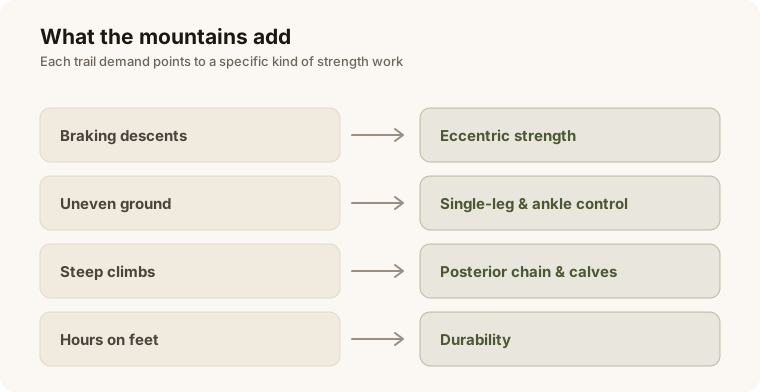
Each demand the mountains add points to a specific kind of strength work.
How much of each? It depends where you are
Here's the part most articles skip. There's no single trail-strength prescription. The right emphasis depends on your training age and your race. The four demands don't change; how much you lean on each does.
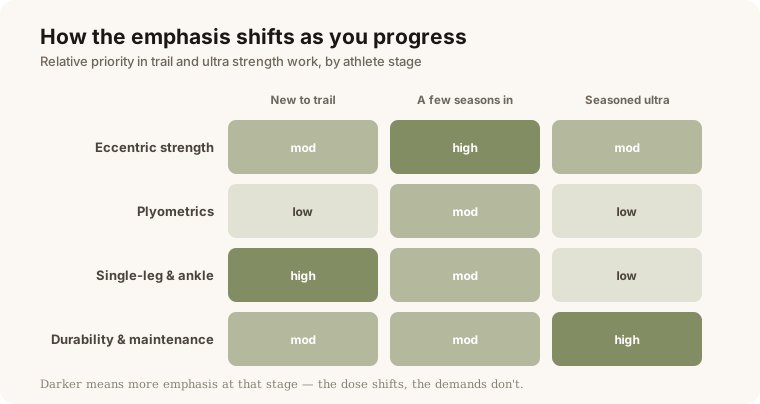
Darker means more emphasis at that stage. The dose shifts; the demands don't.
New to trail. Your job is to build a base and a body that tolerates the terrain, not to chase race-specific peaks. The biggest gains come from the terrain skills you're missing, single-leg control and ankle strength. Ease gently into eccentric work and downhill running so your legs adapt before a race demands it. Your running volume is still modest, so a real strength habit is easy to fit and well worth it.
A few seasons in. Now the descents become the priority. Eccentric strength and structured downhill running move to the front ahead of a hilly race, while you keep a little reactive work for technical ground. As your long runs and climbing volume grow, strength gradually gives way to running. Its job now is to support your training, not add fatigue to it.
Seasoned ultra-runner. At high volume, the trail itself maintains most of your strength and control. The gym's job narrows to two things: keeping you durable and injury-free. That means minimal work, kept deliberately out of the way of your running, while the real descent-specific training happens where it belongs, on actual hills.
Timing the downhill work
Protection against descent damage is partly specific. Your legs adapt to the repeated downhill running itself (Eston 2000), so you can't bank it all in the gym. Build eccentric strength through your base, bring in real downhill running in the block before a hilly race, peak with your most race-like descents, then ease off to arrive fresh.
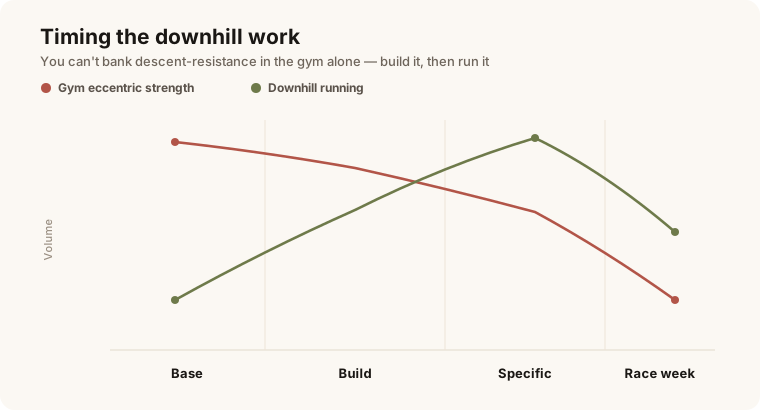
Build the tissue in the gym first, then let real descents do the specific work.
Adjust for your race
The four demands aren't equal in every race. Read the course and bias accordingly:
- Runnable or rolling: lean toward sustained strength and posterior chain for steady output. The descents matter, but they're not the headline.
- Big vert or technical (alpine, steep and rocky): eccentric strength, downhill running and ankle control become non-negotiable, with real calf and posterior-chain strength for the climbs. This is where neglecting the descents ends races.
Don't forget what carries over
None of this replaces the road basics. You still want heavy, compound lifting for the economy gains (Blagrove 2018), it still cuts injury risk to a fraction (Lauersen 2014), and you still keep your hardest lifting and hardest running on different days so they don't blunt each other (Wilson 2012). Trail strength is those fundamentals plus the four demands, never instead of them.
The descents are what you remember
When I ran UTA100, I assumed the big climbs would be the hard part. What actually caught me out were the stairs, the relentless steps between the Katoomba Aquatic Centre and the Fairmont Resort. They were a genuine surprise, and I could feel the force driving straight into my knees and quads on every step down. That damage didn't stay behind me. It followed me. By the back end of the race those quads had far less to give, and every remaining descent was harder than it should have been.
No amount of aerobic fitness would have fixed that. The thing I'd have banked more of, if I ran it again, is exactly what this article is about: eccentric strength and downhill-specific work. Train the demand the mountain actually makes.
Bottom line
Keep your road strength foundation, then layer on the four things the mountains add: eccentric strength for the descents, single-leg and ankle work for the terrain, posterior chain and calves for the climbs, and durability for the hours. How much of each depends on where you are and what your race demands. Build the base when you're new, sharpen the descents when you're chasing a race, and protect your legs when you're deep in the big weeks.
Frequently asked questions
How is strength training for trail runners different from road runners?
The foundations are the same — heavy compound lifting for economy and injury resistance — but trail and ultra add four demands the road doesn't: braking descents (eccentric strength), uneven ground (single-leg and ankle control), steep climbs (posterior chain and calves) and hours on feet (durability). How much you emphasise each depends on your experience and your race.
What's the best strength work for downhill running?
Eccentric strength. Your quads brake your bodyweight on every downhill step, and that lengthening-under-load contraction is what causes the damage and soreness (Eston 1995). Building eccentric strength plus doing real downhill running — which the body adapts to specifically — is what protects your legs on long descents.
Should ultra runners do plyometrics?
Some, but it isn't the priority it is for road or track runners. Newer trail runners keep it minimal; developing runners use a moderate amount for foot speed on technical ground; seasoned high-volume ultra runners often de-emphasise it because the fatigue cost is too high against their running load, and the trail itself provides plenty of reactive stimulus.
How do you fit strength training around high running volume?
As volume climbs, strength shifts from a development tool to a maintenance one. A newer runner can lift two solid sessions a week; a seasoned ultra runner deep in big weeks drops to minimal, brief strength work kept deliberately out of the way of the running, aiming to stay durable and injury-free rather than to get stronger.
Want help with strength training for trail and ultra running?
Book a call